From early days at sea to building a more sustainable future for coastal transportation
By Kathy A. Smith
Captain Darren Pereira doesn’t hesitate when asked about the future of coastal ferries. His perspective, shaped by decades at sea and now a leadership role at CIRQL Ferries, comes with both urgency and clarity.
Sea time started early. Pereira spent his summers as a boy sailing with his father on container ships, travelling from Japan through Asia, India, and Egypt, and into Europe. He entered BCIT directly after high school, then spent his first eight years at sea with Algoma Central Corporation. During that time, he quickly progressed through the ranks from cadet to chief officer on bulk carriers and self-unloaders.
“The Great Lakes was a fascinating journey. It was a lot of hard work, long hours,” he explains. “Sometimes we did nine ports in seven days. We moved everything from grain to iron ore to coal, all the raw aggregates, from Thunder Bay right up to Bay Como on the east coast. It was incredible being part of international trade; not just learning the trade but actually being part of it.”
Learning to Lead at Sea
Being an ambitious young man, he learned early how to lead. It wasn’t always smooth sailing when, at the tender age of 22, he had to figure out how to give commands to “big, burly seafarers” as he put it. But it didn’t take him long to find his footing. “I showed them a lot of respect, and they, in turn, showed me respect. It was a phenomenal experience. You mature up real fast.”
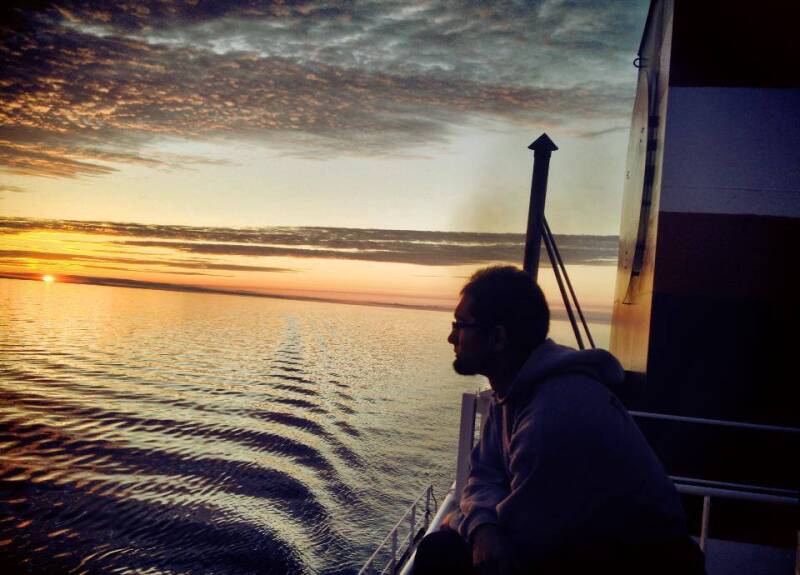
Pereira enjoying the view from the wing bridge aboard M/V Algolake working on Lake Superior body of water for Algoma Central Corporation.
Photo courtesy Darren Pereira.
Pereira also advanced in the ranks again when he was given the opportunity to work at BC Ferries in 2016. He quipped that it afforded the prospect of going home to sleep in his own bed at night, something not afforded on Great Lakes voyages.
He began his tenure as a second officer and, over the next eight years, progressed through a series of roles, eventually becoming captain, fleet captain, and senior captain, while working the Langdale, Horseshoe Bay and Tsawwassen routes. “One of my favourite chief officer moments was when I was chief officer of the Queen of New Westminster, and the senior master practically handed the keys to me to the ship and said, ‘I want you to run the ship for me.’ And I did, and I loved every aspect of it.”
Experiences like that helped shape his perspective on leadership, one that has evolved significantly over time and remains grounded in the realities of working at sea.
“Back in the day, it was definitely the authoritarian, dictatorship style of do as I say and don’t question it,” he says. “I think that had its time and place back then. However, today’s way of leading a crew encourages empathy.”
That shift, he believes, is grounded in a simple idea. “I always say that a ship isn’t a ship without its crew, and I’ve always approached my leadership with the sense of respecting the crew, acknowledging who they are and what they do, and empowering them to do their jobs. I take a human-centered, holistic approach to leadership."
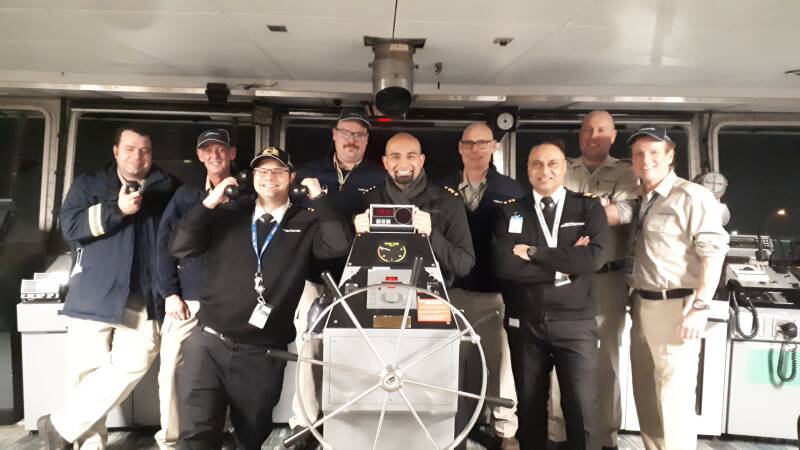
Pereira's crew of the Queen of Surrey in 2020. Photo courtesy of Darren Pereira.
From Ships to Systems: Navigating Change
That people-first mindset has remained constant, even as ships and the technology behind them, have changed significantly over the course of his career.
“When I was a cadet, I sailed on the SS Quebecois, and that was one of the last steam ships in Canada. It was a traditional laker,” Pereira explains. “It had the aft and forward end houses, old steam turbines and boilers. It was fascinating to be on that ship. You’d think it would be noisy, but it wasn’t.”
He also recalls working aboard M/V Canadian Transfer assembled from multiple ships, an experience that left a lasting impression. “The oldest part of the ship was built in 1942. I slept in my survival suit a few times because I was terrified of that ship,” he recalls.
Onboard technology has certainly made dramatic shifts over time. “When I first started sailing with my dad, the first ship had the old cathode ray radar with the green sweeps that go around and you had to have a cover on the radar because in the daytime you couldn’t see it and you had to have a greased pencil to put markings on it,” he says.
Today’s systems are far more advanced. “Now you see electronic charts, integrated bridges. Now AI is coming out, too, with detection technologies and you can see automation coming in as well,” he explains. Yet for all the advantages, the transition has not been seamless. "Technology can evolve really quickly, but the people who are working with the technology haven't quite adapted to it yet," he says.
That gap, he notes, can lead to over-reliance that can result in mistakes. For example, the ECDIS and radar overlays can
lead to numerous alarms that burden and distract a navigator, explains Pereira. "We call it alarm fatigue, which can force one to put the instruments on 'silent mode,' which, in turn, could silence a very necessary alarm."
Having seen both the benefits and the challenges of that evolution firsthand, Pereira is now focused on shaping what comes next.
Charting a New Course for Coastal Ferries

In 2024, he made the move to CIRQL Ferries (formerly Greenline Ferries) as Co-Founder and Chief Operating Officer, stepping into a role centered on advancing sustainable marine transportation on BC’s coast.
It aligns with his operational background and his ambition to be at the forefront of industry change. “I made this move because I felt a responsibility to help lead the industry towards a cleaner, net-zero future, and I was quite aware of the need for passenger-only ferries in our region,” he says.
For inspiration, he looks to Nordic countries, which he describes as “leagues ahead on sustainability.”
“In Canada, we’re at the stage where we’re still talking about it. I’d like to see less talking, more action,” he says. "With CIRQL Ferries, we’re actually doing something. We’re deploying sustainable innovation.”
(Left) Pereira and his son Hayes, with CIRQL Ferries CEO Callum Campbell at the COAST Ocean Innovation Hub in Victoria.
Photo courtesy of Darren Pereira.
The company is expected to launch its electric ferry service connecting Vancouver to Bowen Island and Gibsons in 2028.
Vessels will depart from an upgraded dock facility at Harbour Green Park, adjacent to Harbour Air and Hullo Ferries in Coal Harbour, and will carry up to 150 passengers, along with 20 bikes and designated spaces for wheelchairs. A unique charge barge, similar to an electric vehicle charging port, would be installed on a new dock segment.
The goal is to run the service like a transportation hub, allowing passengers to easily connect with existing transit links in the city. “Once we have electric ferries, and we expand on our routes, there’s no going back,” says Pereira.
Coming full circle, in addition to his role at CIRQL, he works alongside his father, as a certified Flag State Inspector and ISM Auditor with Sigma Marine Services Inc. He also consults on Safety Management Systems and operational reviews for clients across British Columbia and Canada.
Additionally, Pereira volunteers with the Greater Vancouver Board of Trade, the Chamber of Shipping BC, the Vancouver Maritime Centre for Climate, and the Western Maritime Community Coalition. This keeps him actively engaged with stakeholders and involved in discussions around regional infrastructure, trade, and supply chains.
A Legacy Shaped at Sea
While he is focused on helping advance a cleaner, more sustainable marine industry, Pereira also thinking about his family. With a 15-month-old son, he is considering the kind of world his son and future generations will inherit.
He recalls a special time sailing at night in the Indian Ocean with his father. “He takes me to the bridge wing and he says, ‘look up.’ I looked up, and my jaw hit the floor. There were so many stars out there that you could see every ripple on the ocean, every detail of the ship just bathed in the silvery green, gray starlight,” he says. “It’s one of those memories you want to put it in your pocket and store it for the rest of your life.”

Pereira and his father performing a ship inspection on a container ship at Deltaport in 2024. Photo courtesy of Darren Pereira.
Perhaps one day, his son will follow in the footsteps—or sea legs—of his father and grandfather. And perhaps, like Pereira at the age of 10, he will find himself standing on the bridge of a ship, looking out at something unforgettable.
For Pereira, that early experience, combined with all those that followed, continue to shape how he leads and how he’s helping to move the industry forward.
© 2026 West Coast Marine Conversations. All rights reserved.
Excerpts may be shared with attribution and a link to the original article.
Full republication requires prior written permission.